
Why Your AI Initiative Is Failing (And It's Not the Technology)
AI doesn't live in IT.
It lives in the bridge between IT & Business.
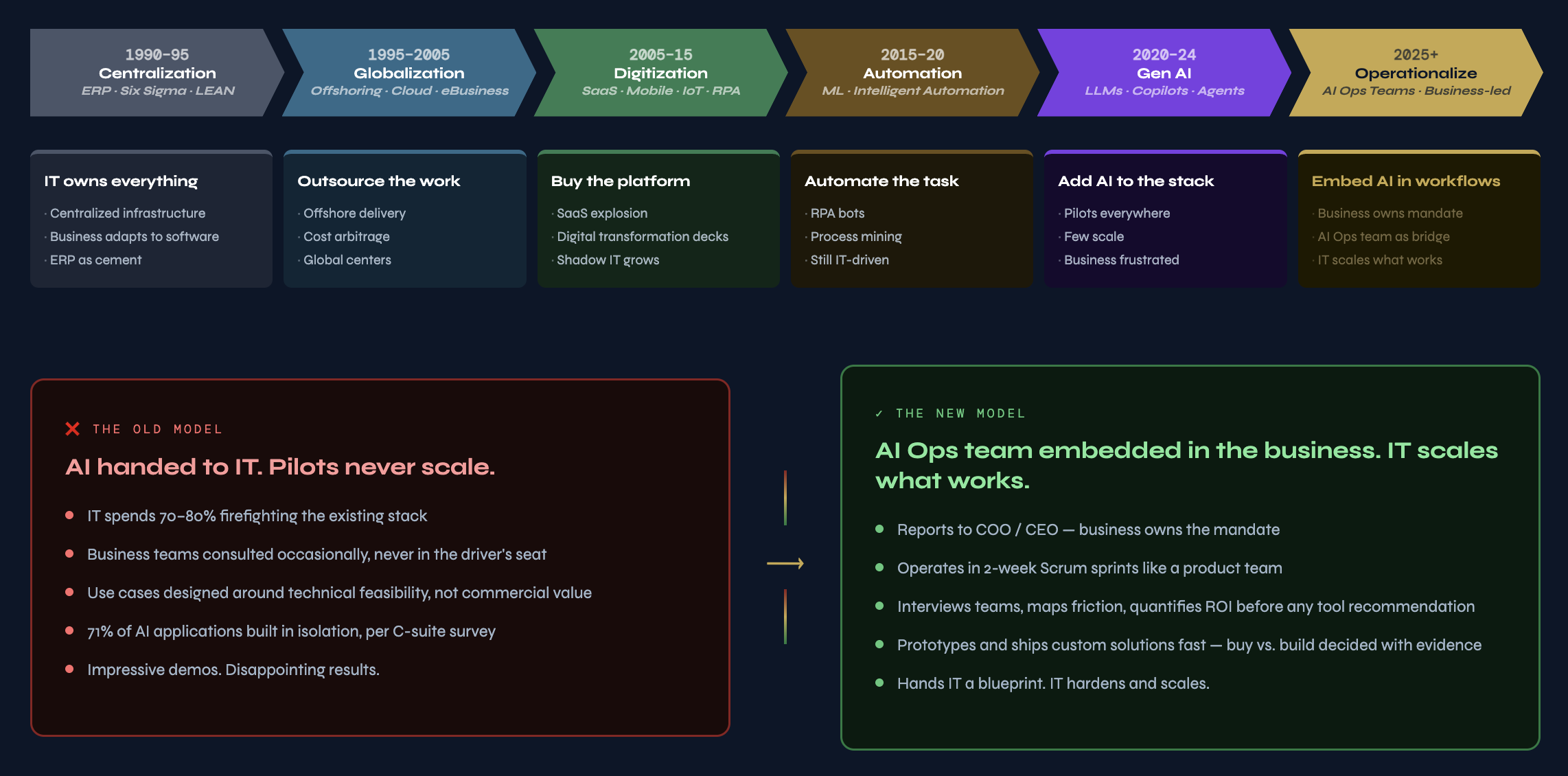
Every decade, enterprises reorganize around a new paradigm. We are now in one. The companies scaling AI all made the same structural decision — they put a cross-functional team between the business and the stack.

There's a number that keeps showing up in AI research and I find it almost funny at this point (after 14 years of a similar song!).
80–90% of companies report using AI in at least one business function. Fewer than 6% report meaningful, repeatable bottom-line impact.
That gap — between "we're doing AI" and "AI is actually working" — is not a technology gap. Everyone has access to the same models. The same APIs. The same cloud credits.
The gap is organizational. And it almost always comes down to the same thing: no one owns the space between the business and the stack.
The reflex that kills AI before it starts
When AI lands on the board agenda, the default move is predictable: hand it to IT.
It feels logical. AI needs infrastructure, data pipelines, security reviews — things IT already owns. So IT gets the mandate, spins up a working group, and six months later you have a very well-documented proof of concept that nobody is using.
Here's the problem. IT teams are already underwater. Research consistently shows they spend 70–80% of their time firefighting — incidents, tech debt, compliance, keeping existing systems alive. Their success metrics are uptime and stability, not EBITDA improvement. Asking that structure to lead a business-wide transformation is like asking your plumber to redesign your house. They'll keep the pipes from bursting. They won't reimagine the floor plan.
What you get when AI lives only in IT: secure infrastructure, a few pilots bolted onto existing systems, and very little rethinking of how work actually gets done.
Where the value actually lives
Here's the thing most AI vendors won't tell you: around 70% of AI value sits in core business functions. Operations. Supply chain. Pricing. Customer experience. You don't unlock that by hiring a data scientist and pointing them at a spreadsheet. You unlock it by reshaping workflows end-to-end — which requires the people who actually understand those workflows.
Domain experts know things that never appear in process maps. The exceptions. The informal workarounds. The step that takes three hours because of a system limitation everyone has just accepted. When those people are trained to think with AI, they become your best use-case generators. Without them, you build technically impressive systems that don't fit reality.
The companies that actually see returns from AI have figured this out. In high-performing firms, over 40% explicitly embed shared governance — business leaders own outcomes, IT enables capabilities. In laggard firms, that number drops to 19%.
When there's no bridge, AI scales chaos
The consequences of the gap are concrete.
71% of executives say AI applications are built in isolation. Nearly half admit employees are left to navigate AI independently — which leads to shadow tools, inconsistent practices, and in at least one documented case, outright sabotage when a CEO tried to use AI to lay off 80% of the workforce without telling anyone first.
The turning point in that same company came when they centralized AI under a Chief AI Officer with a cross-functional mandate — someone sitting between strategy, business, and IT, connecting dots that were previously invisible to each silo.
Without that person or team in the middle, every function runs its own experiments, nobody shares learnings, and the organization collectively wastes an enormous amount of money arriving at the same dead ends in parallel.
What an AI Ops team actually does
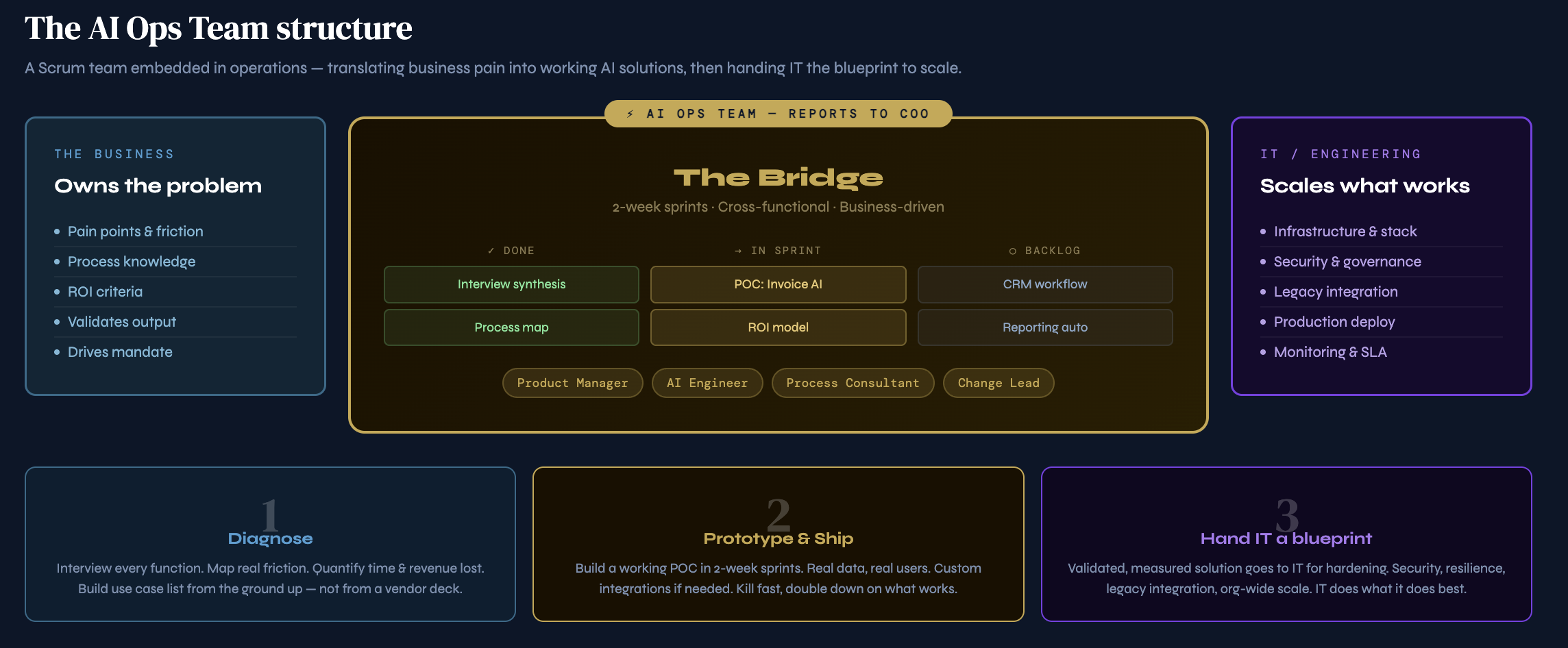
It's a small group. Three to five people, ideally. It sits at the intersection of the C-suite, the business owners who run the P&Ls, and IT. Its job is not to own all AI across the company. Its job is to make AI investable and scalable for everyone else.
In practice that means four things:
Start from the value-creation plan, not the technology. Where does the company need growth, margin, or risk reduction? Quantify the pain first — cycle time, error rate, manual hours, churn. Then ask where AI changes those numbers.
Map the real workflow, not the official one. This requires sitting with the people who actually do the work, not reading the SOP. The exceptions and handoffs and workarounds are where the opportunity lives.
Prototype with the people who will use it. Iterate fast on prompts, UX, guardrails. Kill what doesn't work. Double down on what does. Don't hand anything to IT until it's already delivering value in a controlled environment.
Hand off cleanly to IT to scale. Once something works, IT does what IT is good at — hardening it, integrating it, keeping it running. Give them clear specs and measured impact so they're not guessing.
The sequence matters. Most organizations try to do all of this inside IT, or all of it inside a central AI team with no business mandate. Neither works.
The real question
If you're a CEO or operating partner, you've probably already bought the tools. You may have hired some AI-adjacent people. You might even have a task force.
The question is whether you have anyone accountable for the space between the strategy deck and the tech stack — someone whose job is to sit in the room with the operations lead, understand what's actually broken, and figure out where AI makes it better.
That role is still rare. Which is probably why the gap between 90% adoption and 6% impact is still so wide.
The technology is not the bottleneck. It hasn't been for a while now.
If you’d like to find out how we make it happen - let’s book a call
